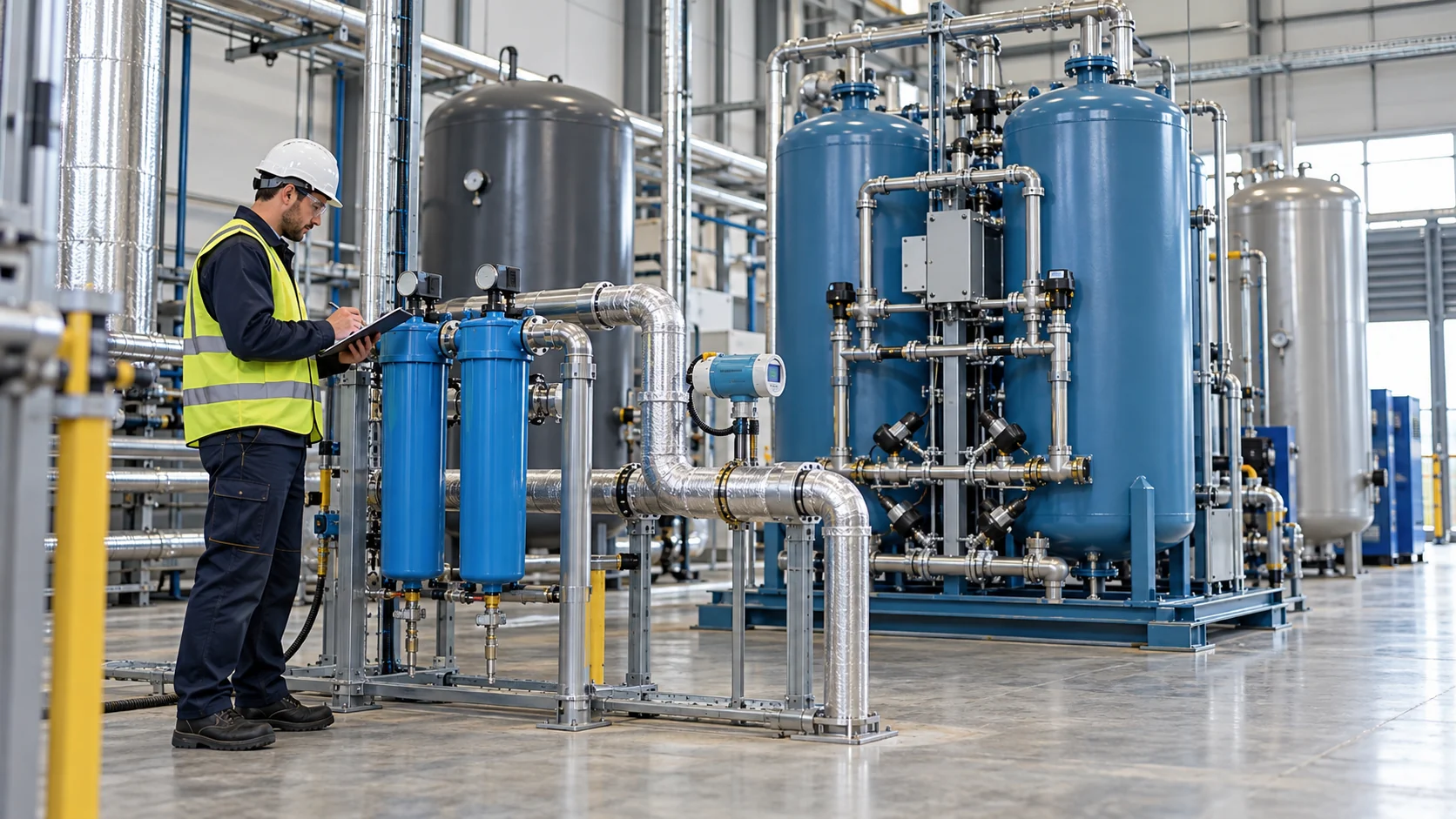
Industrial nitrogen gas quality
Nitrogen dew point is the temperature at which water vapour in the gas would begin to condense at a stated pressure. It is not the same as nitrogen purity or residual oxygen. A useful specification names the gas, measurement location, operating pressure, maximum allowable dew point and test condition. Check the compressed-air dryer upstream of the generator separately from the nitrogen delivered to the process.
Dew Point Measures Moisture, Not Nitrogen Purity
When gas cools to its dew point, its water vapour reaches saturation and may condense. At the same pressure, a lower dew point means less water vapour. A nitrogen analysis showing 99.9% nitrogen does not tell the buyer whether the remaining content includes too much moisture for the process. Conversely, a dry stream is not automatically low in oxygen. Define the nitrogen purity requirement and moisture limit as separate acceptance items.
Pressure matters. “−40°C dew point” without a pressure basis is incomplete. The sample may be read at full line pressure or after a regulator has expanded it to near atmospheric pressure. Those readings are not interchangeable even when the gas has not acquired new water vapour. The CAGI air-drying selection guide explicitly includes a chart for converting dew point between pressures.
| Quantity | What it answers | What it does not answer |
|---|---|---|
| Residual oxygen / nitrogen purity | How much oxygen remains in the delivered nitrogen | Whether the stream is dry enough |
| Compressed-air pressure dew point | How dry the feed air is at the defined point before the generator | The guaranteed moisture content at the process connection |
| Nitrogen pressure dew point | Moisture condition of the product gas at the stated pressure and sample point | Whether oxygen purity or downstream piping is acceptable |
First Protect the Generator; Then Specify the Product Gas
The first moisture boundary is the compressed air entering a PSA or membrane unit. Compression, aftercooling, separation, drainage, drying and filtration must work as a system. A coalescing filter removes liquid aerosol; it does not replace a dryer that removes water vapour. If a drain fails or the dryer is overloaded, wet air can reach the separation equipment.
The second boundary is the nitrogen outlet or point of use. The generator may deliver nitrogen drier than its inlet air, but that is not permission to assume an outlet value. Ask the supplier for the selected model’s performance data at the stated flow, purity, inlet quality and operating conditions, then separately consider water picked up from downstream vessels or pipework.
One Parker DB1200–DB9000 PSA manual calls for clean, dry inlet air and recommends an aftercooler, refrigerated dryer, water separator and final filtration. Its suggested feed-air dew point is 40°F or better. The same manual warns that excess water, oil or particles can contaminate CMS and valves, compromising the stated purity. This is a model-family instruction, not a universal target for every generator or an outlet nitrogen guarantee.
ISO 8573-1:2010 can express particle, water and oil classes for compressed air at a specified location. If an RFQ cites it for generator feed air, name the class and measurement point. A separate product-gas dew-point specification is still needed when the process requires one.
Evidence: Parker DB1200–DB9000 installation manual; ISO 8573-1:2010 scope; CAGI compressed-air treatment handbook.
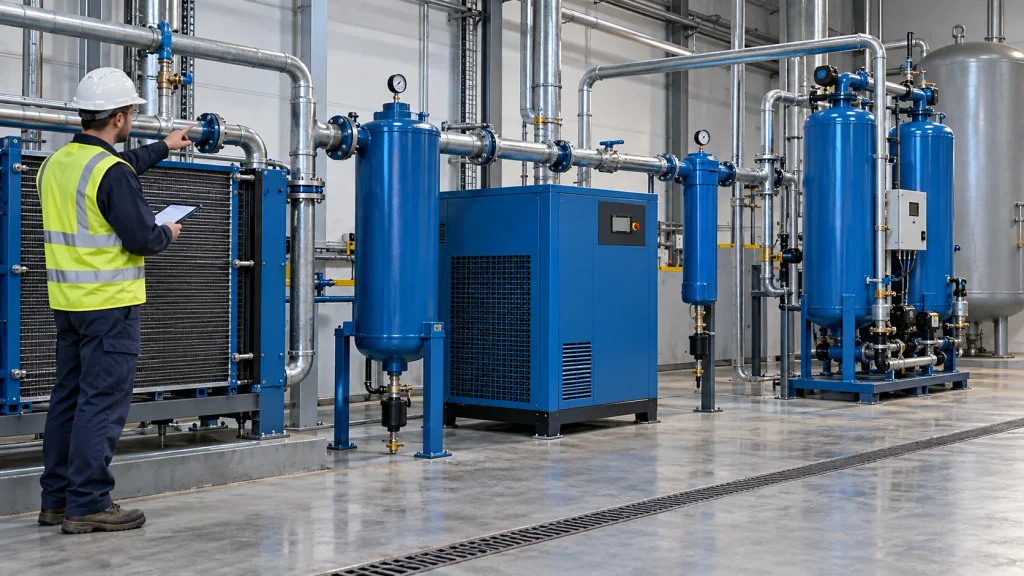
Pressure Dew Point and Atmospheric Dew Point Are Not the Same Reading
Imagine a technician measuring nitrogen from a 7 barg header through a regulator that vents the sample to atmospheric pressure. The analyzer may report a lower dew-point temperature than a probe exposed to the same gas at header pressure. Nothing about that comparison proves the dryer improved. The pressure changed. A supplier quoting “−40°C” at atmospheric sampling pressure cannot be compared directly with one quoting “−40°C pressure dew point at 7 barg.”
For every reading, write down the sample point, gauge or absolute pressure, sample-line arrangement, gas temperature, flow through the analyzer, instrument calibration status and whether the displayed value is measured or pressure-corrected. If the sample is reduced in pressure, use the instrument maker’s method and actual pressures for conversion; do not apply an assumed universal offset.
Vaisala’s compressed-air sampling guidance notes that gas-pressure changes alter the dew-point reading and that sample handling can introduce measurement error. The ISO 8573-3 humidity-measurement method is relevant to compressed-air testing; the selected analyzer’s approved method governs the nitrogen acceptance measurement.
How to choose the target without over-drying
Work backwards from the process: What is the coldest credible temperature of the pipe, vessel or product? Does liquid water create corrosion, freezing, coating defects, instrument faults or a product-specification failure? Is the requirement at generator outlet or at the final connection? A dew point lower than the coldest exposed surface provides a starting margin against condensation, but the appropriate margin and limit depend on the application and site conditions.
The CAGI handbook makes this practical: outdoor compressed-air lines can face a different minimum temperature than an indoor dryer room, and selecting an unnecessarily low dew point increases equipment or operating cost. Dryer type should follow the required duty, not a reflexive “lowest possible” number.
Measurement basis: Vaisala sampling-cell application note; CAGI air-drying selection guide.
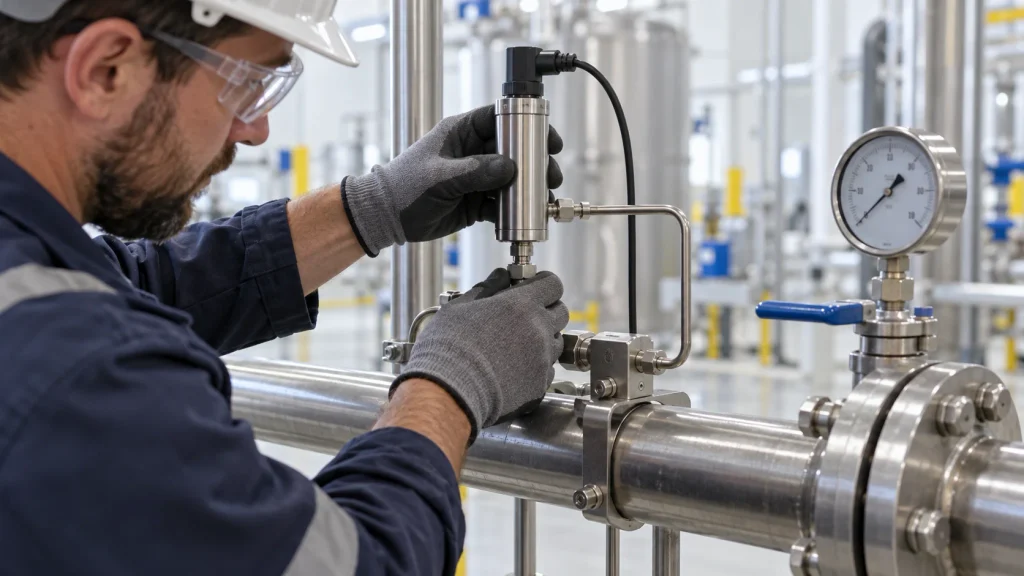
Two Site Scenarios That Change the Specification
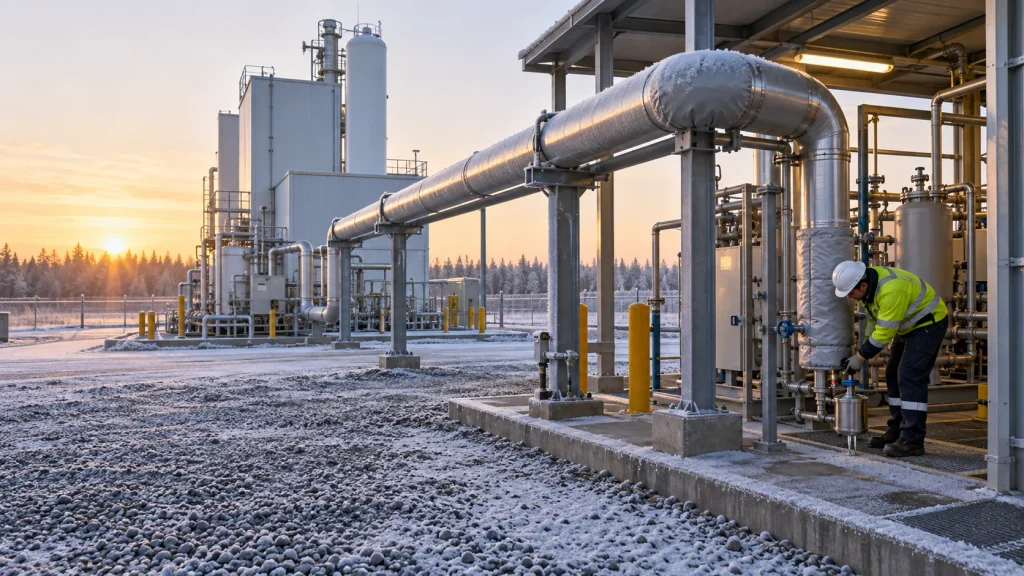
Scenario 1: An outdoor line cools overnight
Illustrative engineering scenario, not a customer case: a generator and dryer sit inside a warm utility room, while nitrogen travels through an external pipe to a packaging process. The room stays above 20°C, but the pipe can fall below freezing overnight. A dry-room inspection does not prove the external line will remain free of condensate. The project team should record the coldest credible line temperature, the pressure at the exposed section and the allowable moisture level at the process. It may need a lower product-gas pressure dew point, better piping layout and a drain/inspection plan. The final target must be approved against the actual process requirement.
Scenario 2: Moisture alarms after dryer service
Diagnostic scenario, not an observed NITRAISE incident: residual oxygen remains within limit, but the nitrogen moisture analyzer alarms following maintenance. Do not immediately replace the generator. First confirm that the analyzer sample pressure and calibration are unchanged. Next check drain operation, dryer bypass position, inlet temperature, filter differential pressure and whether peak compressed-air demand exceeds dryer capacity. Then compare readings before the generator and at the nitrogen outlet under the same operating load.
That order distinguishes a sampling error, an overloaded pretreatment system, a generator-side issue and downstream water pickup. The CAGI dryer guide explicitly warns that a sudden demand exceeding dryer rating can raise the downstream dew point; it also discusses a receiver after the dryer as one way to cover a short demand spike. This does not mean a receiver fixes a sustained undersized dryer.
The first prevents an indoor specification from being copied to a colder outdoor duty. The second prevents a product-quality alarm from being blamed on the nitrogen generator before the feed-air and measurement boundaries are checked.
Specify Where and How the Reading Is Taken
Choose the sample point according to the contractual boundary. At a minimum, define an upstream compressed-air point after the dryer and filters and a product-gas point at the generator outlet. If the process guarantee is at the machine, provide a suitable sampling point there as well. Record normal and peak flow when testing, since an idle system may conceal dryer overload or downstream wet pockets.
- Verify the analyzer is suitable for nitrogen, the expected range and the actual line pressure.
- Use clean sample tubing and a controlled flow; avoid dead legs, leaks and materials that hold moisture.
- Allow the reading to stabilize under the agreed operating condition and document calibration/check-gas status.
- Record the measured value together with sample pressure, temperature, location, date and equipment state.
- If the sample is expanded, state the conversion method and report both the measured and line-pressure-equivalent values where appropriate.
Instrument and sampling cautions: Vaisala compressed-air sampling note; ISO 8573-3 measurement scope.
A Dew-Point Line You Can Put in an RFQ
A quotation should not say only “dry nitrogen.” It should identify each required test boundary. This section covers dew point; the nitrogen generator RFQ checklist covers the other inputs. The following is an illustrative wording pattern; replace bracketed fields with project-approved values:
“At [defined nitrogen delivery point], at [normal and maximum flow] and [operating pressure], nitrogen pressure dew point shall not exceed [project-approved °C value], measured at [sample point] by [approved method] after steady operation for [agreed duration]. The feed-air quality at the generator inlet shall be specified separately. Supplier shall state test conditions, instrument details and any excluded downstream pipework.”
| RFQ field | Buyer must provide | Why it changes the answer |
|---|---|---|
| Process and coldest exposed condition | Application, indoor/outdoor route, minimum line or product temperature | Defines condensation risk and whether the target is process-driven |
| Product-gas duty | Normal and peak Nm³/h, operating hours, purity and pressure | Dryer and generator performance must be checked at actual load |
| Dew-point target | Maximum allowed °C and whether at line pressure or atmospheric sample pressure | Stops unlike measurements from being compared |
| Guarantee point | Generator outlet, after storage, or final process connection | Defines responsibility for downstream pickup |
| Feed-air quality | Compressor type, inlet temperature, contaminants, selected ISO 8573-1 class if applicable | Protects pretreatment and separation equipment |
| Acceptance test | Sampling location, analyzer method, stabilization period and load condition | Turns a brochure claim into a repeatable check |
The nitrogen generator sizing guide covers the other inputs needed for a package decision. Dew point belongs alongside purity and delivery pressure; it cannot be selected from a single catalogue figure.
Questions Buyers Ask
What dew point does a nitrogen generator produce?
There is no universal value. The achievable product-gas dew point depends on the selected technology and model, inlet-air treatment, operating flow, pressure, ambient conditions and downstream system. Request a guarantee at a named point and test condition.
Can a particulate or coalescing filter replace a dryer?
No. Filters can remove particles and liquid aerosols; drying equipment addresses water vapour and pressure dew point. Specify both where the feed-air quality requires them.
Is −40°C dew point always necessary?
No. The target follows the process moisture limit and coldest credible system condition. A needlessly low target can increase equipment and operating cost; a marginal target can permit condensation. Also state the pressure basis before comparing −40°C claims.
Does ISO 8573-1 certify my nitrogen outlet?
No. ISO 8573-1 classifies contaminants in compressed air. It can be used to state feed-air quality at a defined point, but the nitrogen outlet requires its own product-gas specification and acceptance method.
Need a project-specific review? Send the application, normal/peak flow, purity, line pressure, coldest exposed temperature, proposed dew-point limit and intended sample point. NITRAISE can use those inputs to discuss a preliminary treatment and generation scope; final equipment ratings and acceptance criteria require engineering approval.
About the author: Henry Xu
Henry Xu is the founder of NITRAISE and a senior industrial equipment engineer with 18 years in nitrogen equipment research, development and production.