
On-Site Nitrogen Fundamentals
An industrial nitrogen generator does not create nitrogen. It separates the nitrogen already present in compressed air from oxygen, water vapour and other gases. Pressure swing adsorption systems use carbon molecular sieve in alternating vessels, while membrane systems use selective permeation through hollow fibres. A complete installation also needs the right air compressor, treatment equipment, controls, gas analysis, storage and—where required—pressure boosting.
A Nitrogen Generator Separates Air—It Does Not Create Nitrogen
Ambient air is already mostly nitrogen, with oxygen making up most of the remainder. An on-site nitrogen system takes that air, compresses it and separates enough oxygen and moisture to produce a nitrogen-rich gas stream at the purity, flow and pressure required by the process.
This distinction matters. The useful output is not defined by the generator cabinet alone. It depends on the complete chain: the condition of the incoming air, the separation technology, the control settings, the storage arrangement and the way the process consumes gas.
The Five Stages of an On-Site Nitrogen System
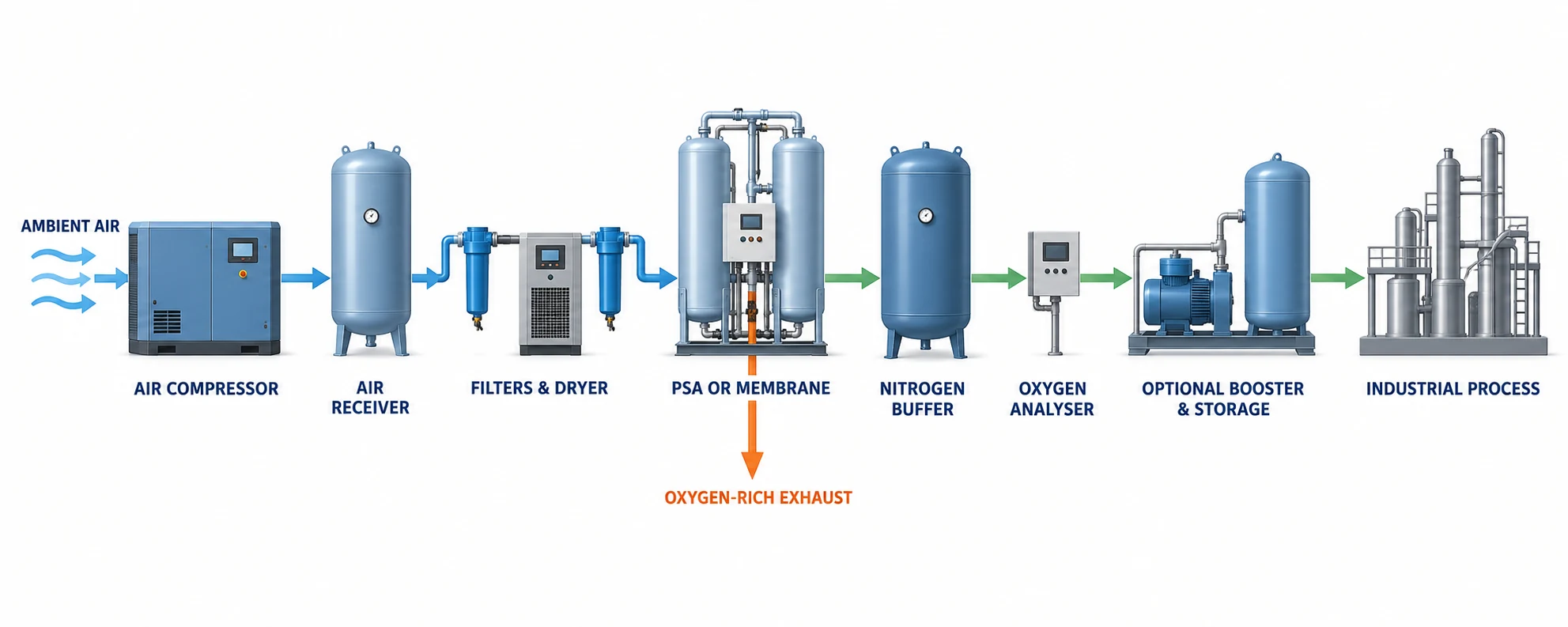
Layouts vary, but an industrial installation usually follows five functional stages. Each stage has to be defined as part of the project rather than assumed to be included with the generator.
-
1. Compress the ambient air
An air compressor supplies the pressure that drives the separation process. The required compressor capacity depends on nitrogen flow, purity, operating pressure, technology, ambient conditions and the efficiency of the selected equipment. A generator flow figure without its compressed-air requirement is not enough to size the upstream system.
-
2. Remove liquid, particles, oil and water vapour
After compression, the air must be conditioned for the separation equipment. A treatment train can include a separator, receiver, coalescing filters, dryer, activated-carbon stage and particulate filter. The exact arrangement depends on compressor type, required inlet-air quality and generator design. The Compressed Air & Gas Institute handbook on air treatment explains the roles of dryers and filters in controlling moisture and contaminants.
-
3. Separate nitrogen from the other gases
The conditioned air enters either a PSA adsorption system or a membrane separation module. The two technologies use different physical mechanisms, so they respond differently to purity targets, load changes, available space and environmental constraints.
-
4. Stabilise and verify the product gas
A buffer or receiver can smooth cyclic production and short demand changes. Pressure, flow and residual oxygen may be monitored before gas is released to the process. If the product is outside the accepted purity limit during start-up or an upset, the control philosophy should define whether it is vented, recycled or isolated.
-
5. Store, boost or distribute the nitrogen
The product gas may be used directly, stored at low pressure or boosted for a higher-pressure application. Pipe size, distance, peak demand and allowable pressure drop affect what reaches the point of use. A low-pressure nitrogen generator is not automatically a complete high-pressure nitrogen supply system.
These stages form a useful boundary for comparing proposals. If one quotation includes a compressor, dryer, analyser, receiver and commissioning while another lists only a separation module, their prices and performance claims are not directly comparable.
How a PSA Nitrogen Generator Works
PSA stands for pressure swing adsorption. In a typical nitrogen system, clean and dry compressed air passes through vessels filled with carbon molecular sieve, commonly abbreviated as CMS. Oxygen and certain trace gases are preferentially adsorbed by the sieve under pressure, while a nitrogen-rich stream continues to the product outlet.
Industrial PSA systems commonly use two adsorber vessels so production can continue while the beds alternate between service and regeneration:
- Adsorption: conditioned compressed air enters the online vessel. Oxygen is preferentially captured by the CMS and nitrogen-rich gas leaves the vessel.
- Equalisation and switching: valves change the flow path and may equalise pressure between beds, depending on the design.
- Depressurisation: the off-line vessel releases pressure, reducing the CMS capacity to retain the previously adsorbed gases.
- Regeneration and repressurisation: the bed is purged and prepared for the next adsorption cycle while the other bed produces nitrogen.
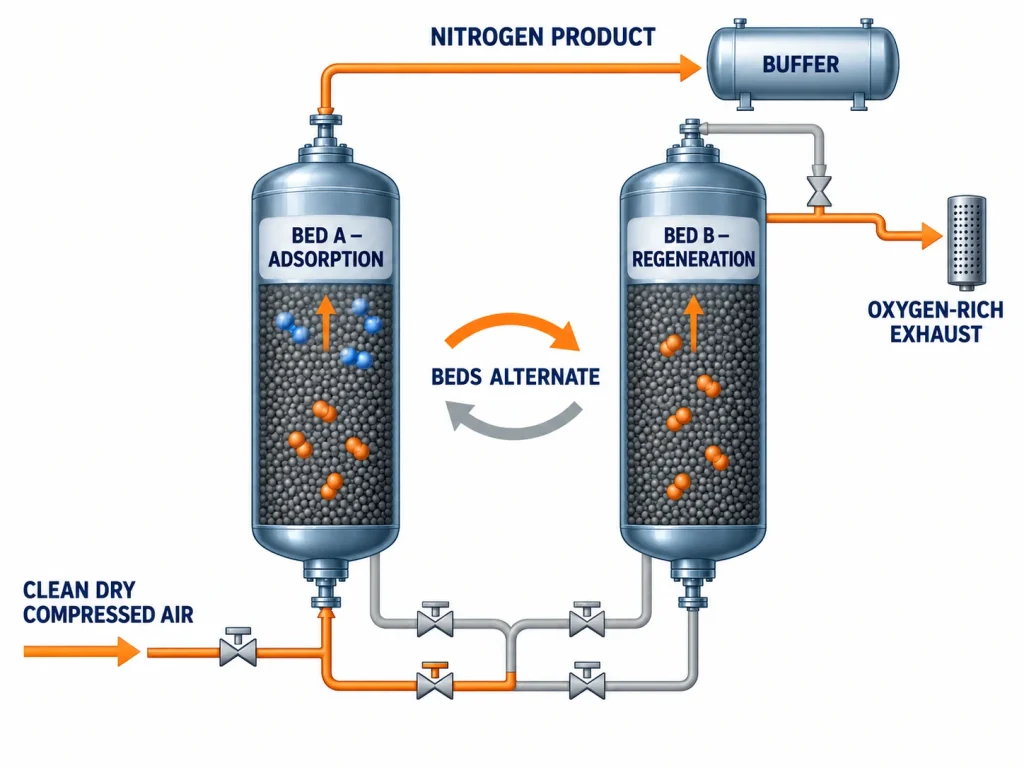
Parker’s technical description of PSA nitrogen generation shows this alternating adsorption and regeneration sequence and the role of the product buffer and control system.
What controls PSA output?
PSA output is not a single fixed number independent of the application. The target residual oxygen, available inlet pressure, air temperature, air quality, cycle control and usable pressure all influence capacity. Asking for higher nitrogen purity usually changes the available flow and compressed-air consumption. That is why proposals should be compared at the same purity, reference conditions and delivery pressure.
What leaves the PSA exhaust?
The regeneration exhaust is enriched in the gases removed from the product stream, particularly oxygen. It must be discharged in a location and manner suitable for the project. Vent routing, noise, ventilation, hazardous-area classification and personnel exposure should be addressed in the installation design rather than treated as an afterthought.
How a Membrane Nitrogen Generator Works
A membrane generator uses bundles of hollow polymer fibres. Conditioned compressed air travels through the fibre bores. Different gases dissolve and diffuse through the membrane wall at different rates. Water vapour, carbon dioxide and oxygen permeate more quickly and leave through the membrane vent, while the slower-permeating nitrogen-rich stream continues to the product outlet.
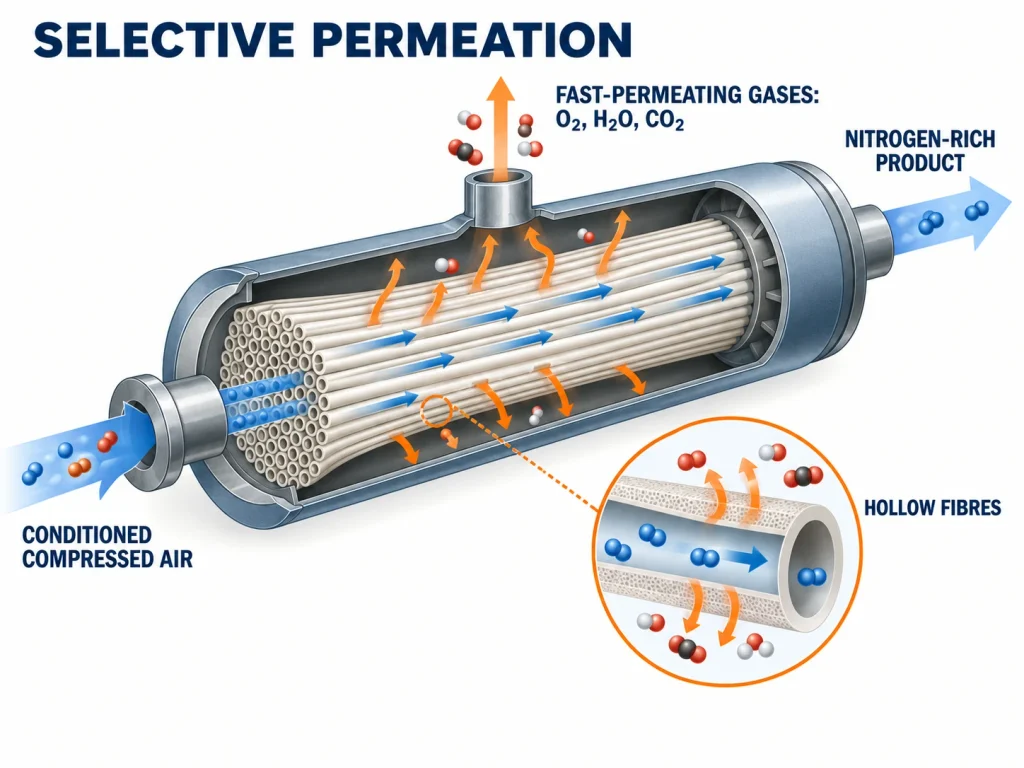
This mechanism is called selective permeation. GENERON’s official explanation of nitrogen membrane separation describes the characteristic permeation rates of the gas components and the function of the hollow-fibre modules.
Why does inlet-air treatment still matter?
A membrane does not remove the need for a defined compressed-air supply. Liquid water, oil and particles can damage or reduce the performance of the treatment and membrane system. The allowable inlet-air condition is equipment-specific, so the supplier’s data sheet and operating manual should govern the final filtration and drying arrangement.
How is membrane purity adjusted?
Membrane performance is influenced by feed pressure, temperature, product flow and the selected recovery. Restricting the product flow can increase nitrogen concentration, while demanding more flow generally changes the residual oxygen level. The exact relationship must come from validated performance data for the selected membrane and stated operating conditions.
PSA and Membrane Nitrogen Generation at a Glance
| Question | PSA | Membrane |
|---|---|---|
| Separation mechanism | Preferential adsorption on carbon molecular sieve | Selective permeation through hollow fibres |
| Operating pattern | Adsorber beds switch between production and regeneration | Continuous flow through the membrane modules |
| Air treatment | Clean, dry compressed air matched to the generator specification | Clean, conditioned compressed air matched to membrane limits |
| Typical selection strength | Often considered when higher purity or a broad purity range is required | Often considered for compact, lightweight or continuously operating packages at suitable purity |
| Project questions | Purity, flow, pressure, ambient conditions, footprint, motion, utilities, maintenance access and lifecycle cost | |
This table is a starting point, not a universal selection rule. A technology that is attractive at one purity or load profile may be less suitable when the operating conditions change. Use the detailed PSA versus membrane selection guide to compare the two routes against a defined duty.
Purity, Flow and Pressure Cannot Be Selected Independently
Many procurement errors begin with a flow requirement that has no stated purity or delivery pressure. “100 Nm³/h of nitrogen” is incomplete if the process oxygen limit, reference condition and usable outlet pressure are unknown.
Purity changes usable capacity
Nitrogen purity is usually the inverse expression of residual oxygen, but the specification should make clear whether other impurities are also controlled. Higher purity generally requires more separation effort. Depending on the technology and equipment, this can reduce product flow, increase compressed-air consumption or change the selected generator size.
Flow has a time profile
Average consumption alone can hide short peaks, batch cycles, start-up purges and future expansion. A receiver may handle a brief surge, while a sustained peak can require more generator capacity. Critical processes may also need redundancy or an independent backup source.
Pressure affects the complete package
The generator outlet pressure, pressure at the user connection and final process pressure may be different. Distribution losses and treatment equipment consume part of the available pressure. Applications requiring substantially higher pressure may need a downstream booster and suitable storage, valves, piping and protection devices.
The practical next step is to define these variables together. NITRAISE’s nitrogen generator sizing guide organises the required inputs before a preliminary configuration is proposed.
A Generator Cabinet Is Not Always a Complete Nitrogen System
The word “generator” is used inconsistently in the market. It may refer only to the PSA vessels or membrane module, a packaged generator with controls and filtration, or an entire plant from the air compressor to the process connection.
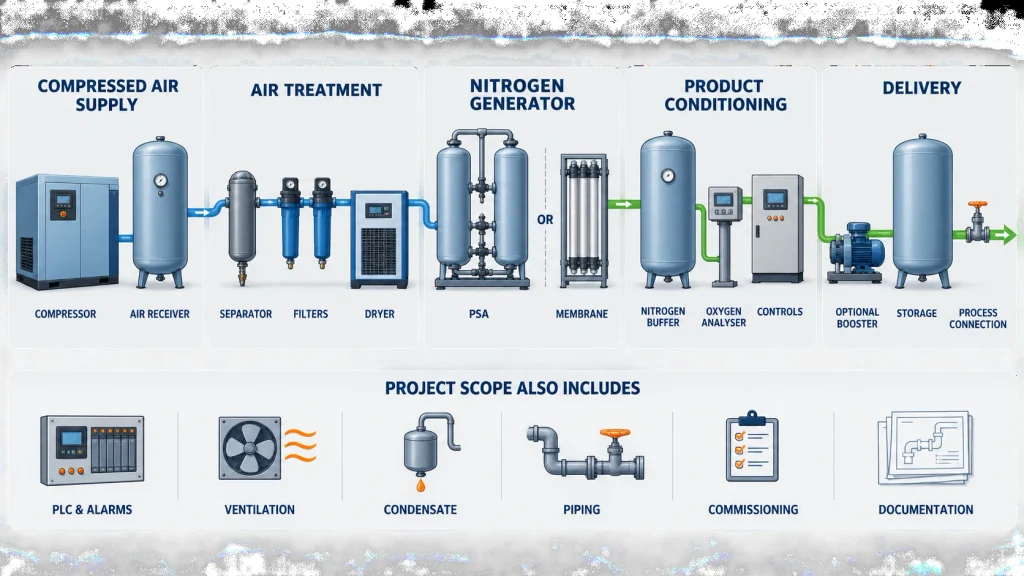
A complete scope can include:
- air compressor and aftercooler;
- air receiver, separators and condensate management;
- coalescing, particulate and vapour-removal filters;
- refrigerated or desiccant dryer;
- PSA vessels or membrane modules;
- nitrogen buffer or product receiver;
- oxygen analyser, flowmeter, pressure instruments and dew-point measurement where required;
- PLC, alarms, remote signals and off-spec gas handling;
- booster, high-pressure storage or distribution equipment;
- skid, enclosure or container, including ventilation and environmental controls;
- backup connection, commissioning, documentation, training and spares.
Before comparing vendors, mark every item as included, optional, by others or not required. This is the only reliable way to distinguish a low equipment price from a complete project scope.
When Does On-Site Nitrogen Generation Fit?
On-site generation is worth evaluating when a process uses nitrogen regularly, requires more control over availability, faces delivery or storage constraints, or can benefit from matching purity to the actual process. It can also be useful at remote sites or in engineered packages where the gas supply must be integrated into a wider plant.
It is not automatically the best answer for every user. Low or highly irregular consumption, very high pressure, unusual impurity limits, restricted utilities, limited maintenance capability or project-specific codes may change the preferred supply method. Delivered liquid or cylinders can remain practical for some loads, backup duty or early project phases.
The decision should compare equivalent system boundaries, gas specifications, operating hours, maintenance, energy, logistics, backup and project risk—not only the purchase price of the separator.
Define These Inputs Before Selecting Equipment
- Application: What process uses the nitrogen, and what problem does it solve?
- Flow: What are the normal, minimum and peak demands, and how long do peaks last?
- Purity: What is the maximum allowable oxygen concentration at the point of use?
- Pressure: What pressure is required at the process connection after distribution losses?
- Dew point and gas quality: Which moisture, oil, particle or other impurity limits apply?
- Operating profile: How many hours per day and days per year will the system run?
- Site conditions: What are the ambient temperature, altitude, location, area classification and space limits?
- Utilities: What compressed air, power, cooling and drainage are available?
- Reliability: Is backup, redundancy or future expansion required?
- Compliance: Which codes, inspection, documentation and acceptance requirements apply?
These inputs turn a general product enquiry into an engineering duty. They also make quotations easier to compare because each supplier is working from the same basis.
Common Questions
Does a nitrogen generator make nitrogen?
No. It separates the nitrogen already present in air. Oxygen, moisture and other gases are removed or diverted to produce a nitrogen-rich product stream.
What is the difference between PSA and membrane nitrogen generation?
PSA uses carbon molecular sieve and alternating pressure cycles to adsorb oxygen and regenerate the sieve beds. A membrane system uses differences in gas permeation rates through hollow fibres. The right choice depends on the complete duty, not the technology name alone.
Does every nitrogen generator need an air compressor?
Industrial PSA and membrane systems require a source of compressed air. A project may use a dedicated compressor or a verified plant-air supply, provided its capacity, pressure and air quality meet the generator requirements.
Can one nitrogen generator provide any purity and pressure?
No. Purity, flow and pressure are linked to the selected technology and equipment. High-pressure applications may require a separate booster, and the achievable performance must be confirmed at the stated inlet and ambient conditions.
Move from Working Principle to a Defined System
For a preliminary review, prepare the application, normal and peak flow, maximum allowable oxygen, required point-of-use pressure, dew point, operating hours and site conditions. NITRAISE can use these inputs to organise the separation technology, air treatment, storage, controls and package boundary for further engineering discussion.
Start with the nitrogen sizing guide
Preliminary selection is not a final performance guarantee. Final equipment, safety provisions and compliance requirements must be confirmed in the project technical agreement and applicable engineering review.