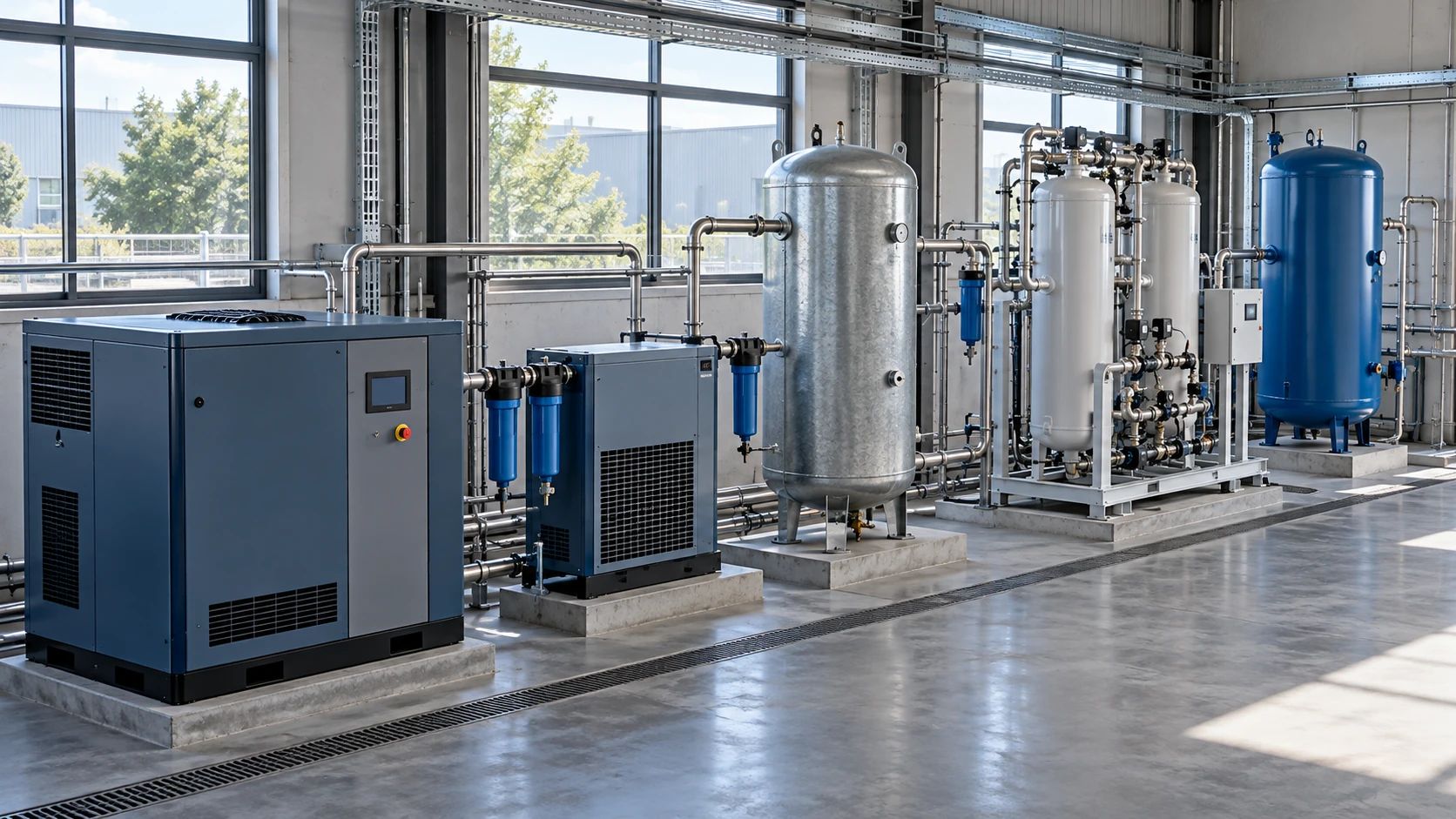
A complete on-site nitrogen system normally includes a compressed-air source, treatment equipment, a PSA or membrane generator, product-gas controls and a connection to the process. Receivers, analysis, pressure boosting, storage and backup supply depend on the duty. The quotation should identify which functions are included, which existing utilities will be reused and who connects each interface.
That last point often determines whether a delivery can start production. A skid can arrive assembled and still need a power feeder, ventilation, condensate disposal, a product pipeline or a backup changeover arrangement. “Complete” becomes useful only when the supplier and site agree where the package starts and ends.
Start with the process requirement: normal and peak nitrogen demand, acceptable oxygen content, pressure at the use point, moisture requirement and operating schedule. The nitrogen system sizing guide helps define those inputs before deciding which equipment belongs in the scope.
Follow the gas path, then check the supporting utilities
A useful review follows five functions: produce compressed air, condition it, separate nitrogen, verify and condition the product gas, and deliver it to the process. The actual arrangement may combine functions inside one enclosure or distribute them around a utility room. Receiver positions and treatment stages must follow the selected equipment design.
| Function | Equipment to identify | Question that closes a scope gap |
|---|---|---|
| Compressed-air supply | Compressor, cooling, inlet arrangement and control | Is the source dedicated, shared or supplied by the customer? |
| Air treatment | Water separation, dryer, filters, drains and condensate handling | Who guarantees the air condition at the generator inlet? |
| Air buffering | Air receiver and associated fittings, where required | What duty and control response determine its location and size? |
| Nitrogen separation | PSA beds or membrane modules, valves and local controls | What product flow is available at the specified purity and inlet conditions? |
| Product acceptance | Oxygen analysis, pressure/flow measurement and off-spec handling, as required | What happens when the gas fails the acceptance condition? |
| Product delivery | Nitrogen receiver, regulator, pipeline; booster and storage if needed | Where must the required pressure and flow be achieved? |
| Continuity and integration | Backup supply, changeover, PLC interfaces, utilities and enclosure | Which failures must the installation tolerate, and for how long? |
The upstream equipment protects the generator
Air compressor and receiver
Ask for the generator’s feed-air requirement at the selected nitrogen flow and purity, including its inlet pressure and temperature limits. A plant compressor that currently supplies tools may have spare average capacity yet struggle when nitrogen production and another large air user run together. Review the coincident demand and pressure at the proposed connection.
An air receiver can help manage demand and pressure fluctuations. It cannot compensate indefinitely for an undersized compressor. Specify the receiver’s duty and its relationship to the compressor and generator controls instead of selecting a vessel from floor space alone.
Dryer, filters and condensate route
Liquid removal, particle filtration, oil control and drying perform different jobs. The selected generator’s inlet specification determines the required treatment. A filter does not automatically provide the moisture removal of a dryer, and a clean-looking pipe says little about the quality of the air flowing through it. The CAGI compressed-air treatment handbook explains these treatment functions and the consequences of contamination and moisture.
On a site walk, trace each drain to its final destination. Include collection or treatment equipment where required, access to replace filter elements, and the allowable pressure loss through the treatment train. These are installation tasks with an owner, even when the separator or filter is already mounted on the skid.
Put the drain destination and maintenance access on the layout before approving the equipment footprint.
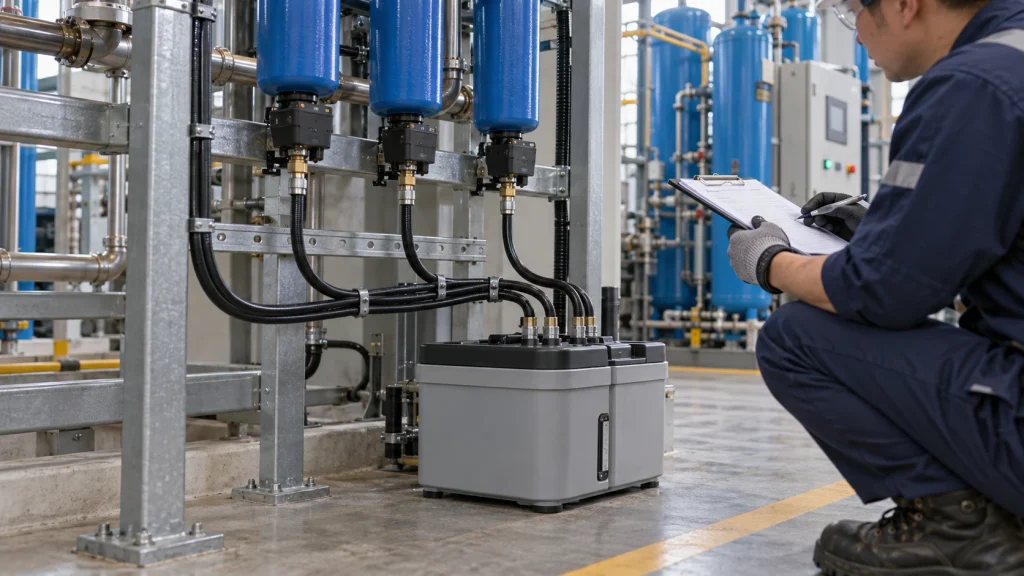
The separation module needs a defined outlet condition
A PSA generator uses adsorbent beds and a controlled valve cycle; a membrane generator uses selective permeation through membrane modules. Both rely on appropriate feed air. Neither technology name tells the buyer whether the quoted package includes air treatment, a product receiver or an analyzer.
For a concrete product example, the Parker N2-120/N2-160/N2-240 membrane-generator manual separates prefiltration, gas separation, flow controls and final filtration. Its oxygen-monitoring section discusses adding analysis and associated alarms or interlocks where oxygen content is critical. This is one product family’s arrangement, not a universal package list.
Request the actual bill of materials and process drawing. If a function is described as “optional,” establish whether the process can operate without it or whether it is merely excluded from the base price. The nitrogen equipment range distinguishes standard generators from broader engineered packages; the project scope still needs to be agreed in writing.
Product receiver, pressure regulation and final filtration
A nitrogen receiver can buffer production and demand. Its usable reserve depends on the permitted pressure range, temperature, connected load and control strategy. Vessel volume alone is insufficient to state how long the process can run. Distinguish a low-pressure product buffer from a high-pressure storage bank.
Confirm the pressure available at the process after regulators, valves and pipe losses. Where the application requires additional particulate or gas-quality control, define that stage and its acceptance point. Do not assume that a stated nitrogen purity also specifies moisture, particles or hydrocarbons.
Analyzer, valves and the action on an alarm
Ask the vendor to describe the start-up sequence in plain language: when the compressor starts, when nitrogen production starts, how product quality is checked, and when the process is allowed to receive gas. The response to an analyzer fault matters as much as its normal reading.
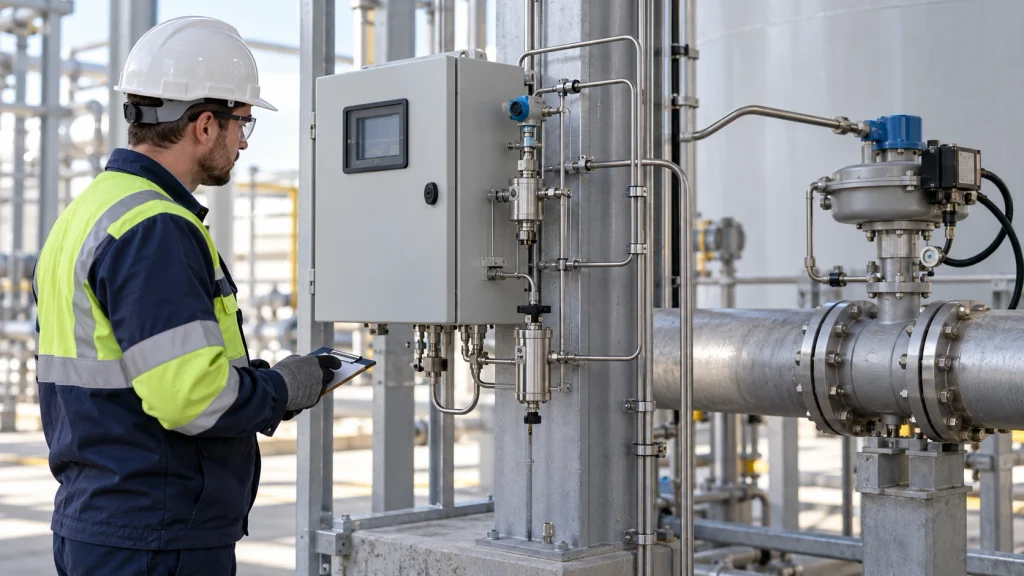
For a process that cannot accept off-spec nitrogen, identify the sampling point and the means of preventing unacceptable gas from reaching the consumer. Specify the required alarm, isolation, diversion or backup action in the control design. The appropriate response depends on the process; an alarm on a screen does not itself stop the gas flow.
The product oxygen analyzer and a room oxygen monitor have different purposes. One checks product quality; the other can form part of the installation’s personnel-protection measures. Ventilation and gas-release arrangements require a site-specific review. Parker’s manual addresses oxygen depletion and oxygen-enriched membrane exhaust as installation considerations.
Agree the cause-and-effect sequence for start-up, analyzer fault and off-spec gas, then include it in the acceptance test.
Two real projects show why the accessory list changes
Laser cutting: storage and boosting support the production duty
In its published Constant Group case study, Atlas Copco describes supplying a temporary rental package after a high-pressure nitrogen service problem, followed by a permanent skid. The reported permanent arrangement combined an air compressor, dry-air receiver, generator, two nitrogen buffers, a booster and high-pressure storage.
The supplier reports 240 Nm³ of stored gas and explains how storage supported the cutting duty. That is a quantity of gas at reference conditions, not a 240 m³ physical vessel. The example shows why a laser-cutting quotation needs a storage and delivery design alongside generator capacity. It is a supplier-reported installation, not a NITRAISE project or a performance guarantee for another factory.
Temporary inerting: the package includes fuel and the last hose
In a 2019 Atlas Copco Rental project in Guadalajara, Mexico, nitrogen delivery access and scheduling complicated a storage-sphere cleaning operation. The described rental solution included a membrane nitrogen generator, an oil-free diesel compressor, a fuel tank and hoses for a two-month assignment. The supplier reports that on-site generation reduced dependence on tanker access and helped the contractor finish its work on time.
The practical lesson is the supply boundary: fuel, connections and delivery to the work area were part of making the temporary installation usable. These details should be specified for a new project rather than assumed from the word “generator.” The case does not establish a general safety outcome, design pressure or saving for other sites.
Backup supply must match the failure you intend to cover
First define the event: generator maintenance, compressor failure, loss of electrical power, an analyzer trip or a short demand peak. A second generator sharing the same failed compressor cannot restore its feed air. Likewise, a cylinder reserve is only useful if its changeover arrangement and available delivery rate meet the process requirement.
Possible arrangements include a second production train, a regulated cylinder bank or a delivered liquid-nitrogen supply with the necessary vaporization and pressure-control equipment. The correct choice depends on required interruption time, gas quality, available space, replenishment and site utilities.
Illustrative duty calculation: a process consuming 30 Nm³/h for a two-hour interruption needs 60 Nm³ of usable nitrogen before allowing for additional demand or a design margin. This calculation defines the required gas quantity; it does not size a vessel or cylinder bank. That requires usable pressure range, temperature, reserve inventory and delivery-rate checks.
A skid or container still has site interfaces
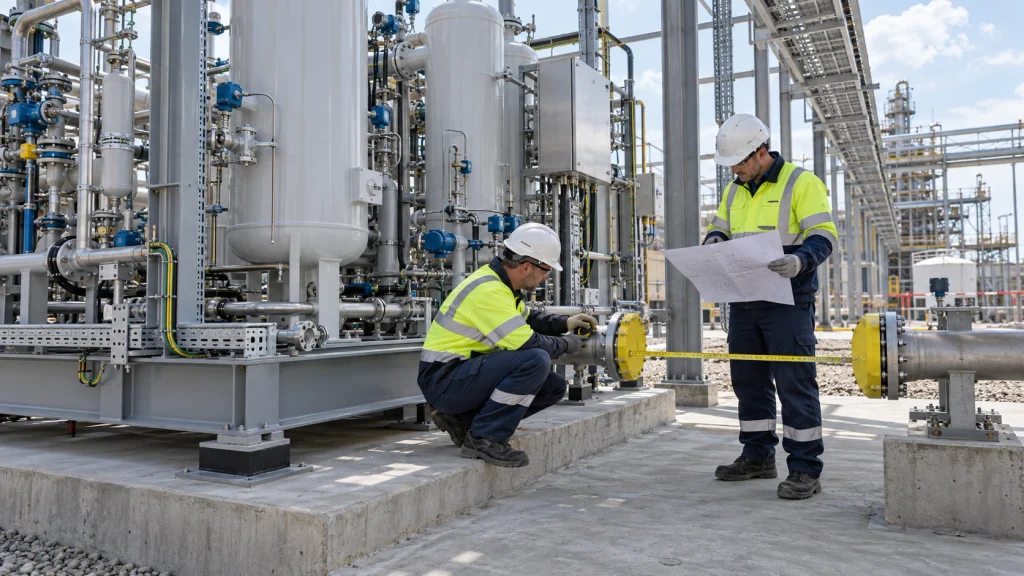
A common frame reduces the number of loose items to install. A container can add enclosure and environmental provisions. Neither term establishes who supplies foundations, the final power connection, exhaust routing, condensate disposal, the product pipeline or communication with the plant.
During layout review, mark the cable entry, nitrogen outlet, drains, vents and access space. Check heat rejection and the proposed air intake, particularly where equipment is enclosed. The containerized and skid-mounted system page covers package formats; use the interface schedule to decide what remains a site task.
Mark the final connection points on the drawing and assign an owner to every connection before shipment.
Use a scope matrix before comparing quotations
For each line below, ask the supplier and site team to name the party responsible for supply, installation, connection and acceptance. “By others” needs a named owner. Where the same item appears in two quotations, compare the function and operating conditions as well as the equipment name.
| Scope item | Information to write into the order | Evidence at handover |
|---|---|---|
| Feed air | Source, available flow, inlet conditions, treatment responsibility | Approved air-duty sheet and operating readings |
| Condensate and vents | Connection points, destination and site routing responsibility | Layout review and installed-route inspection |
| Nitrogen outlet | Exact flange/connection, purity, flow, pressure and moisture basis | Agreed product test at the defined acceptance point |
| Electrical and controls | Power characteristics, cable boundary, I/O list and alarm actions | Electrical checks and witnessed control sequence |
| Booster and storage | Operating duty, usable gas reserve, pressure regulation and interfaces | Documentation and project-specific functional checks |
| Backup | Failure covered, interruption allowance, usable reserve and changeover | Agreed changeover test under representative conditions |
| Site works and support | Foundation, ventilation, access, final piping, commissioning and training | Completed responsibility list and open-item register |
A factory acceptance test can check assembly and agreed functions under the factory’s available conditions. It cannot automatically verify the customer’s installed pipe pressure loss, final ventilation or interaction with other utility users. Identify which checks are factory tests and which require site commissioning, and make any simulated conditions explicit.
Questions buyers ask about a complete system
Can we reuse the existing compressor?
Possibly. Verify simultaneous air demand, pressure at the connection, air quality, control behaviour and the consequence of a compressor outage. Reusing equipment should be a documented design choice, with its scope and acceptance responsibility clear.
Does every installation need a nitrogen booster?
No. It depends on the pressure required at the point of use and the pressure available from the generator after losses. A booster, storage and pressure regulation should be included where the delivery duty requires them.
Does an analyzer guarantee acceptable nitrogen reaches the process?
It provides a measurement. The sampling arrangement, response, alarm settings and connected control action determine what happens to unacceptable gas. Specify and test that complete sequence.
What should “turnkey” include?
It should mean the particular supply, site work, commissioning and acceptance duties listed in the contract. Ask where the vendor’s responsibility ends physically and functionally. The word alone does not identify the final cable, pipe, drain or backup connection.
Define the gas specification and operating cost
Use these guides alongside the scope matrix to specify the gas delivered to the process and compare complete packages.
- Nitrogen purity and residual oxygen requirements
- Inlet, outlet and point-of-use nitrogen pressure
- Nitrogen dew point and moisture verification
- Complete-system nitrogen energy consumption
Send the operating duty with the scope list
For a preliminary review, provide normal and peak flow, maximum acceptable oxygen, point-of-use pressure, moisture requirement, operating hours and site conditions. Add the existing air supply, power availability, required interruption coverage and the connection points shown on your layout.
Send your duty and proposed supply boundary to NITRAISE to request a preliminary configuration and scope review. The useful output is a list of equipment and interfaces with named responsibilities, ready to be checked against the site’s actual conditions.
About the author: Henry Xu
Henry Xu is the founder of NITRAISE and a senior industrial equipment engineer with 18 years in nitrogen equipment research, development and production.