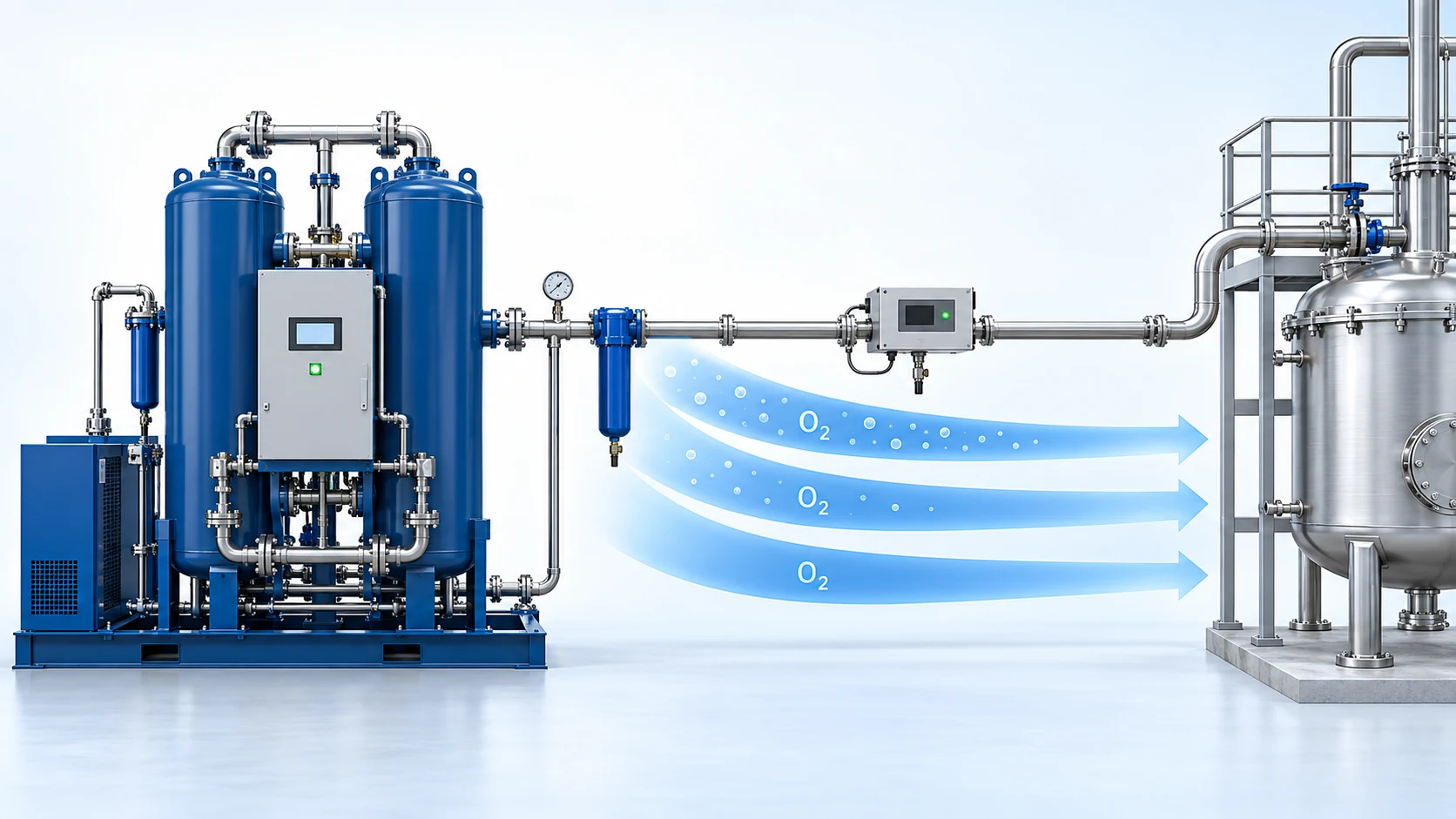
Industrial Nitrogen Selection
Choose nitrogen purity from the process oxygen limit—not from the highest number a generator can produce. First define what oxygen can do to the product or operation, then specify the maximum residual oxygen at a named measurement point and operating condition. The familiar figures 99.9%, 99.99% and 99.999% represent progressively smaller impurity balances, but they are not complete specifications by themselves.
What Nitrogen Purity Do You Need?
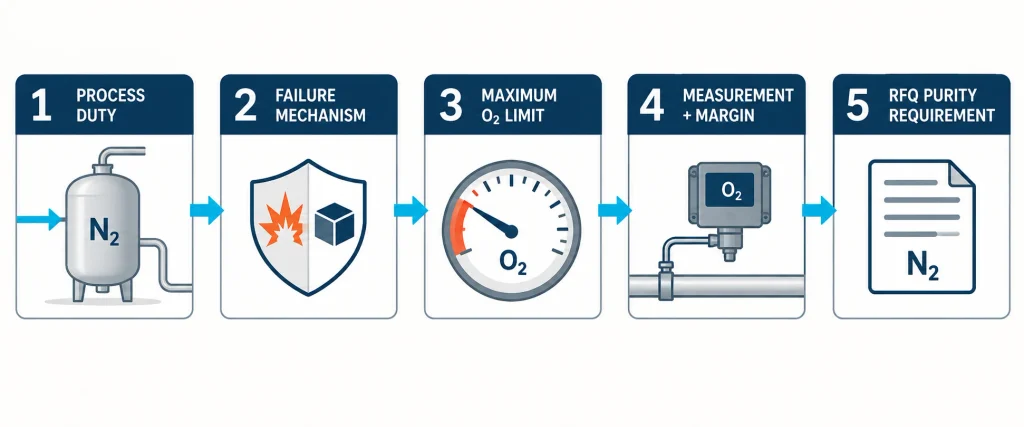
You need the lowest nitrogen purity that reliably keeps oxygen—and any other critical impurity—below the process limit at the point of use. That limit may come from product trials, reaction chemistry, corrosion control, fire and explosion engineering, a customer specification, or an applicable standard. State it as a maximum residual oxygen concentration where practical, then define flow, pressure, temperature, dew point, measurement location and acceptance method.
“As pure as possible” is not an engineering duty. It can lead to a larger generator, higher compressed-air demand and less available nitrogen flow without improving the process. The right target is the minimum adequate purity with a justified operating margin.
This article explains how to build that target. It is a selection guide, not a substitute for process testing, a HAZOP, local regulation or a project-specific gas specification.
Nitrogen Purity, Residual Oxygen and Total Impurities Are Not Identical
A nitrogen purity value is normally a volume or mole fraction. At first glance, 99.9% nitrogen appears to leave 0.1% for everything else. That arithmetic is correct, but the remaining fraction is not automatically all oxygen. Depending on the production method and specification basis, the balance can include argon, oxygen, moisture, carbon dioxide and other controlled or uncontrolled trace components.
On-site generator literature often expresses performance as remaining oxygen content because oxygen is the main process variable being separated and monitored. Some gas specifications, however, state a nitrogen assay that includes argon with nitrogen or controls several impurities separately. Parker’s food-gas technical paper, for example, notes that an assay can include inert gases such as argon and defines purity through the measured impurity balance.
Therefore, a technically complete enquiry should not say only “99.99% nitrogen”. It should answer three questions:
- Is the figure a nitrogen assay, an equivalent nitrogen purity, or a value calculated from residual oxygen?
- Which impurities besides oxygen have independent limits, such as moisture, oil, particles, carbon monoxide or hydrocarbons?
- Where and under what operating condition will compliance be measured?
99.9%, 99.99% and 99.999% Nitrogen Compared
The table below converts each purity figure into its mathematical balance. The oxygen column is valid only when the specification treats oxygen as the relevant balance impurity. If other gases are included, specify them separately rather than assuming the entire balance is oxygen.
| Stated nitrogen purity | Theoretical total impurity balance | Equivalent balance in ppmv | If specified as maximum O₂ | What still needs definition |
|---|---|---|---|---|
| 99.9% | 0.1% | 1,000 ppmv | ≤1,000 ppmv O₂ | Other impurities, measurement point and operating condition |
| 99.99% | 0.01% | 100 ppmv | ≤100 ppmv O₂ | Analyzer range, sampling system and acceptance margin |
| 99.999% | 0.001% | 10 ppmv | ≤10 ppmv O₂ | Trace-level leakage, calibration, sample materials and verification method |
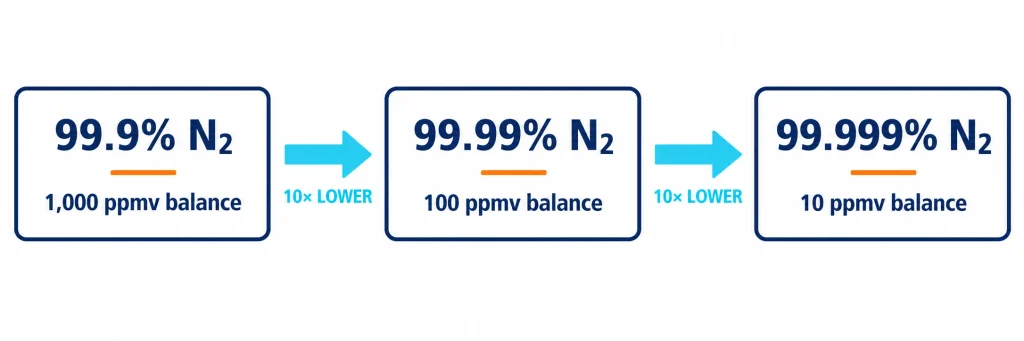
One percentage point is not a useful way to describe the difference at this end of the scale. Moving from 99.9% to 99.99% reduces the theoretical impurity balance by a factor of ten; moving to 99.999% reduces it by another factor of ten. That difference can materially change generator sizing, instrumentation and leak control.
Why Higher Purity Changes Flow, Air Demand and Equipment Size
Higher purity requires the separation system to reject more oxygen from each unit of product gas. The exact response depends on the equipment, technology, inlet pressure, temperature, air quality and control method, but the engineering direction is consistent: purity, flow and compressed-air demand cannot be selected independently.
Official PSA performance tables illustrate this relationship. For the same model and stated inlet conditions, Parker lists progressively lower nitrogen outlet flow as remaining oxygen is reduced from percentage levels towards low ppm levels. Atlas Copco likewise notes that higher purity demands more compressed air input and can require a larger system. These are examples of the underlying trade-off—not transferable performance guarantees for another manufacturer’s equipment.
What changes when the target becomes more stringent?
- Available product flow may fall. A given separator has to operate at a lower recovery or different cycle condition to remove more oxygen.
- Compressed-air demand per usable unit of nitrogen may rise. The compressor is commonly the main electrical load in an on-site system.
- The selected generator and compressor may become larger. The package still has to deliver the required flow at the more stringent purity.
- Instrumentation becomes more demanding. A percentage-range analyser is not automatically suitable for a 10 ppm acceptance limit.
- Small leaks and sampling errors matter more. Air ingress that is insignificant at a percentage-level limit can dominate a low-ppm reading.
For this reason, the economic question is not “Can the system make 99.999%?” It is “Does the process require 10 ppmv oxygen, and what system delivers that limit reliably at the required flow and pressure?”
Determine the Maximum Allowable Oxygen from the Process
The process should set the purity—not a generic industry chart. Two plants in the same industry can need different oxygen limits because their materials, temperatures, residence times, packaging equipment, safety basis and product-quality targets differ.
Start with the failure mechanism
Ask what happens if oxygen is too high. The relevant mechanism might be oxidation, combustion, corrosion, moisture pickup, colour or flavour change, shortened shelf life, unwanted reaction, poor soldering or cutting quality, or failure to meet a customer specification. The acceptable oxygen level should be linked to that mechanism and supported by process evidence.
Separate gas purity from the final process result
Generator outlet purity does not guarantee the oxygen concentration inside a vessel, package or pipeline. Initial air, leaks, seals, purge method, mixing, dead legs, product entrainment and consumption rate all affect the final result. For example, a packaging process may have a higher residual oxygen level in the finished pack than in the incoming nitrogen because air is introduced with the product or remains in the headspace.
Use application ranges only as screening information
Published examples can help start a discussion, but they should be labelled as typical considerations rather than universal requirements. Food-contact gas, pharmaceutical production, electronics, chemical inerting and hazardous operations can also carry separate impurity, documentation or regulatory obligations. The project specification must take precedence.
Questions that establish the limit
- What process outcome is nitrogen protecting?
- Which impurity creates the risk: oxygen, moisture, oil, particles, another gas, or several together?
- What is the maximum acceptable value at the actual point of use?
- Is the limit continuous, an average, or a short-duration maximum?
- What margin is needed for analyzer uncertainty, load changes and site conditions?
- How will the process handle off-spec gas during start-up or an upset?
How PSA and Membrane Technology Fit the Purity Requirement
Both PSA and membrane systems can produce nitrogen-rich gas from compressed air, but they achieve and control purity differently. The correct technology depends on the complete duty: residual oxygen, normal and peak flow, delivery pressure, ambient conditions, footprint, motion, turndown, maintenance philosophy and lifecycle cost.
PSA nitrogen generation
PSA systems use carbon molecular sieve in alternating adsorption and regeneration vessels. Suitable PSA equipment can be configured across a broad purity range, and some published industrial models are rated down to low-ppm remaining oxygen under stated conditions. The achievable outlet and air demand remain model- and condition-specific. See the nitrogen generator working-principle guide for the full cycle.
Membrane nitrogen generation
Membrane systems use selective permeation through hollow fibres. Product purity is influenced by feed pressure, temperature, product flow and recovery. Reducing product flow can raise nitrogen concentration, while pursuing a more stringent oxygen limit generally changes feed-air demand. A membrane’s practical range must be taken from the selected module’s verified performance data, not from a universal cut-off value.
Do not choose the technology from purity alone
A purity target may narrow the options, but it does not finish the selection. Compactness, weight, cyclic or continuous duty, marine motion, available pressure, ambient temperature, response to load changes and maintenance access can alter the result. Use the PSA versus membrane selection guide when both routes remain technically possible.
Specify Where and How Purity Will Be Measured
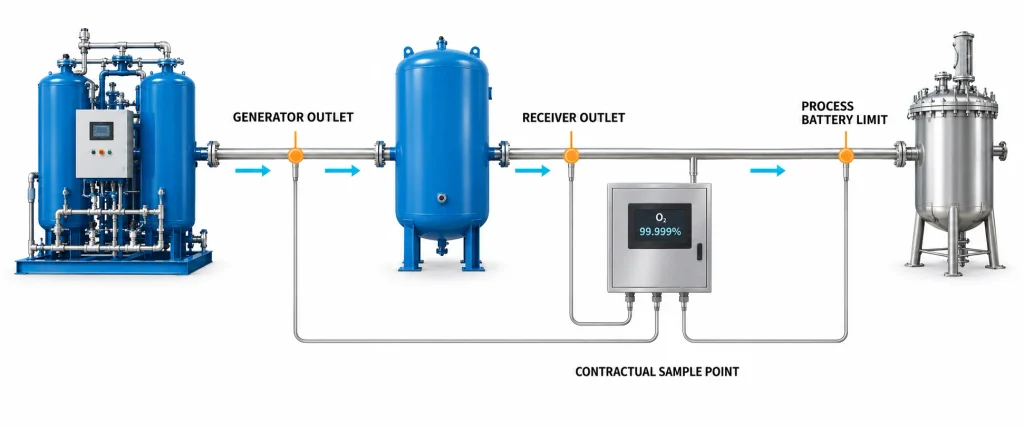
A purity number without a measurement plan is difficult to enforce. The generator outlet, downstream receiver and process connection can show different results because of mixing, residence time, leakage and distribution conditions. Name the contractual measurement point and distinguish it from any local process sensor used for control.
Match the analyser to the limit
The oxygen analyser needs a suitable measurement principle, range, resolution, response time and environmental rating. A sensor intended for percentage oxygen should not be assumed to verify a low-ppm specification. At trace levels, sample tubing, regulators, fittings, leaks, dead volume and purging practice can affect the result.
Define calibration and traceability
The acceptance plan should state the zero and span gases, calibration frequency, certificate requirements and allowable uncertainty. Servomex’s official oxygen-analyser manual, for example, calls for a known oxygen span gas and high-purity nitrogen for zero adjustment; the exact gases and procedure must match the selected analyser and target range.
Define operating and acceptance conditions
State when the reading is valid: after warm-up and stabilisation, at a defined product flow and pressure, within an ambient-temperature range, and after the sample system has been purged. Also define how long the value must remain within limit, whether start-up gas is diverted, and what happens after an alarm.
| Item | Question to define | Why it matters |
|---|---|---|
| Measurement point | Generator outlet, receiver outlet or process battery limit? | Downstream leakage and mixing can change the reading. |
| Basis and unit | N₂ assay, equivalent purity, % O₂ or ppmv O₂? | Prevents different interpretations of the same percentage. |
| Operating condition | At what flow, pressure, temperature and duty state? | Generator performance varies with operating conditions. |
| Instrument | What range, accuracy, response and calibration apply? | The instrument must resolve the contractual limit. |
| Acceptance rule | Maximum value, duration, test method and witness requirements? | Makes factory and site acceptance repeatable. |
How to Write a Nitrogen Purity Requirement in an RFQ
Use a measurable oxygen limit rather than an unsupported string of nines whenever oxygen is the actual process concern. Then add the system conditions that make the limit meaningful.
RFQ wording example
“The system shall deliver nitrogen with residual oxygen not exceeding [X ppmv or % v/v] at the [named battery-limit location], while supplying [normal and peak flow] at [minimum delivery pressure]. Compliance shall be demonstrated after stabilisation at the stated operating condition using a calibrated analyser with an appropriate range. State the nitrogen-purity calculation basis and all separately controlled impurity limits, including dew point where applicable.”
Add the following project inputs:
- application and reason for the oxygen limit;
- normal, minimum and peak nitrogen flow, including peak duration;
- required pressure at the point of use and allowable pressure drop;
- dew point and any oil, particle or trace-gas limits;
- ambient temperature, altitude, indoor or outdoor location and area classification;
- operating hours, turndown, redundancy and backup philosophy;
- off-spec diversion, alarm and shutdown requirements;
- factory and site acceptance procedure, documents and witness points.
Once these values are known, continue with the nitrogen generator sizing guide. Equipment should be compared at the same purity basis, flow reference condition, delivery pressure and package boundary.
Common Questions
What nitrogen purity do I need?
You need the lowest purity that keeps residual oxygen and other critical impurities below the process limit at the point of use. Establish the limit from process risk, product trials, customer requirements and applicable standards, then add an appropriate engineering margin.
What is the difference between 99.9%, 99.99% and 99.999% nitrogen?
The theoretical total impurity balances are 1,000, 100 and 10 ppmv respectively. These values equal maximum oxygen only when the specification defines the balance that way; argon, moisture and other impurities may need separate treatment.
How pure can a PSA nitrogen generator make nitrogen?
Some industrial PSA equipment is rated to low-ppm remaining oxygen under specified inlet pressure, temperature and flow conditions. The applicable limit must come from the selected model’s verified performance data and the complete project duty, not from a generic technology claim.
Does higher nitrogen purity increase energy consumption?
It commonly increases the separation effort and compressed-air requirement per unit of usable nitrogen, or reduces the available outlet flow from a given generator. The actual energy change depends on the generator, compressor, pressure, controls and load profile, so compare proposals at an identical duty and energy boundary.
Define the Oxygen Limit Before Selecting the Generator
For a preliminary configuration review, send NITRAISE the application, maximum allowable oxygen, normal and peak flow, point-of-use pressure, dew point, operating profile and site conditions. We can then organise the purity basis, separation route, air treatment, storage, analysis and package boundary for the next engineering discussion.
About the author: Henry Xu
Henry Xu is the founder of NITRAISE and a senior industrial equipment engineer with 18 years in nitrogen equipment research, development and production.