Nitrogen Technology Selection
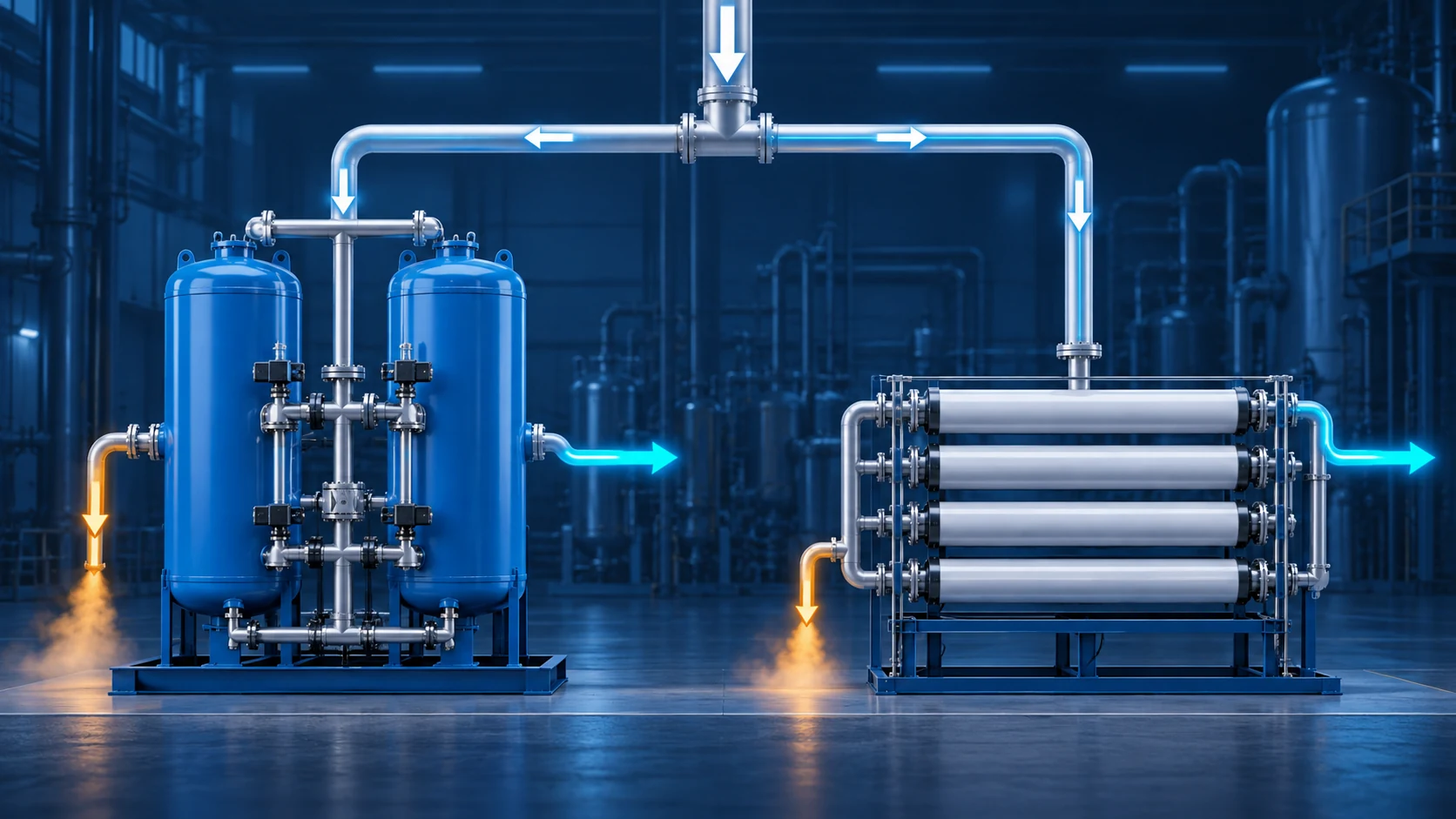
PSA is usually the stronger starting point when a project needs higher nitrogen purity and stable continuous duty. Membrane technology is often attractive when moderate purity, fast start-up, compactness, low weight, few switching components or motion tolerance matter. Neither is universally more efficient or less expensive. Compare them at the same nitrogen flow, purity, pressure, operating hours, inlet-air condition and package boundary.
PSA vs Membrane Nitrogen Generator: Quick Comparison
The practical choice starts with the process, not the equipment label. A requirement for 99.999% nitrogen, for example, is a different duty from 95% nitrogen on a moving offshore package. A technology that looks smaller or cheaper at one purity may not retain that advantage when flow, pressure, air treatment and redundancy are aligned.
| Decision factor | PSA | Membrane | What to verify |
|---|---|---|---|
| Typical selection direction | Often favoured as purity rises | Often favoured for moderate-purity duties | Quoted model at required flow, pressure and ambient condition |
| Separation method | Carbon molecular sieve adsorbs oxygen preferentially in alternating vessels | Hollow fibres allow faster gases to permeate preferentially | Feed-air specification and control philosophy |
| Operation | Cyclic adsorption, depressurisation and regeneration | Continuous selective permeation with no adsorption-bed switching | Start-up, turndown, venting and off-spec handling |
| Mechanical arrangement | Usually twin adsorber vessels with switching valves | Compact membrane modules with relatively few moving parts in the separation stage | Complete skid size and weight, not generator module alone |
| Environment | Suitable for many fixed industrial duties when designed for the site | Often considered for compact, mobile, marine or offshore packages | Temperature, motion, vibration, corrosion, hazardous area and class requirements |
| Energy comparison | No universal winner | Compressed-air input and total package power at the same usable nitrogen duty | |
| Maintenance focus | Valves, actuators, silencers, analyser, filters and adsorbent protection | Filters, analyser, module protection and performance monitoring | Service scope, intervals, spares and replacement assumptions |
Selection rule: eliminate any option that cannot meet the gas specification and site constraints. Then compare the remaining designs on total installed scope, air demand, availability, maintenance and lifecycle cost.
How PSA and Membrane Nitrogen Generators Work
Both technologies start with compressed ambient air and produce a nitrogen-rich stream by removing oxygen and other gases. They differ in the physical mechanism and in how the separation stage operates.
PSA: alternating adsorption and regeneration
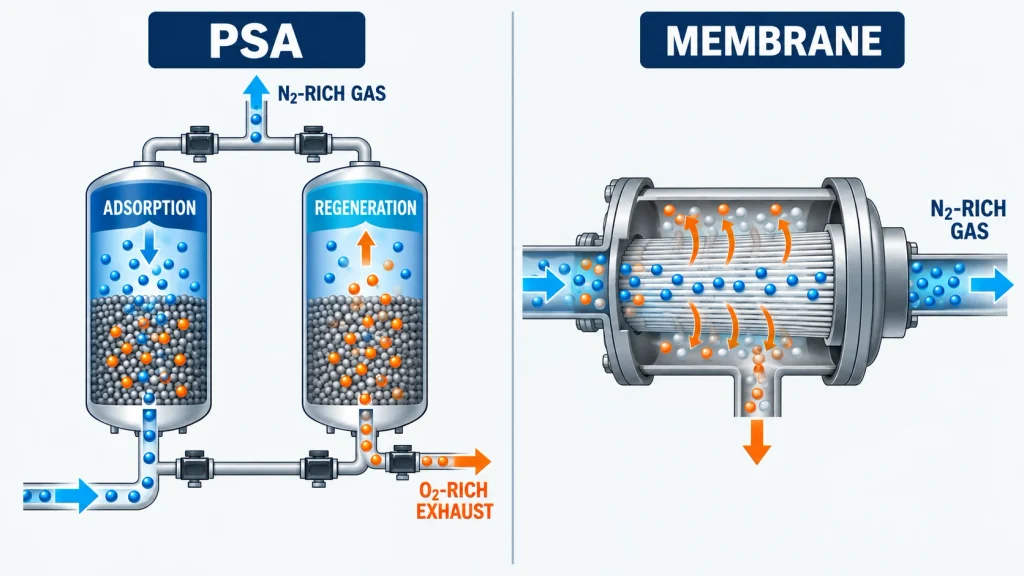
A pressure swing adsorption generator normally uses two vessels filled with carbon molecular sieve. Clean, dry compressed air enters one pressurised vessel. The sieve preferentially adsorbs oxygen and some other gases while nitrogen-rich gas continues to the product outlet. Before that bed becomes saturated, the control system switches the flow to the second vessel. The first vessel depressurises and regenerates, releasing the adsorbed gases to the exhaust.
The paired beds repeat this cycle to provide a continuous product stream. Valve timing, pressure equalisation, vessel design, carbon molecular sieve and the condition of the inlet air all influence performance. For a fuller process explanation, see the nitrogen generator working-principle guide.
Membrane: selective permeation through hollow fibres
A membrane generator sends clean compressed air through bundles of hollow fibres. Gases do not pass through the fibre wall at the same rate. Water vapour, carbon dioxide and oxygen generally permeate faster and leave as a permeate stream, while a nitrogen-rich retentate stream travels to the product outlet.
The separation stage is continuous rather than based on alternating adsorption beds. Product purity and recovery depend on membrane properties, feed pressure, temperature, flow and the selected operating point. The exhaust is oxygen-enriched relative to the feed and must be discharged to a suitable location defined by the system design and site safety review.
Purity and Usable Flow Must Be Compared Together
PSA is commonly selected for higher-purity duties, while membrane systems are frequently used at moderate purity. This is a useful first filter, but it is not a universal cut-off. Published product families overlap, and performance depends on the required flow, pressure, ambient condition and vendor design.
For example, Atlas Copco publishes product-family ranges of 97–99.999% for certain PSA equipment and 90–99% for certain membrane equipment. Those figures illustrate the general selection direction; they are not limits for every supplier. The only relevant value for procurement is the guaranteed performance of the proposed model at the stated duty.
Increasing purity means rejecting more oxygen. That normally reduces the nitrogen recovered from a given amount of feed air or increases the feed-air requirement for a fixed product flow. A quotation at 95% nitrogen cannot be compared directly with one at 99.999%, even if both list the same Nm³/h.
Compressed Air and Energy: Define the Boundary First
The generator controller may use little electrical power compared with the air compressor, but that does not make the separation process energy-free. For many on-site systems, compressed-air production is the dominant energy input. Dryer purge, pressure drop, cooling, ventilation, analysers, valves, pumps and any nitrogen booster can add to the total.
Statements such as “membrane uses less energy” or “PSA is more efficient” are incomplete without a duty point. The result can change with purity, product pressure, feed temperature, compressor efficiency, load factor and control method. A fair comparison should show:
- usable nitrogen flow at the battery limit, not theoretical generator capacity;
- nitrogen purity and allowable off-spec period;
- product and point-of-use pressure;
- required inlet-air flow, pressure and quality;
- compressor shaft or package power at expected ambient conditions;
- dryer purge or refrigeration load and all auxiliary power;
- venting, regeneration and part-load losses;
- booster and cooling power when high-pressure nitrogen is required.
Ask suppliers to report a defined specific-energy basis, such as kWh per Nm³ of usable nitrogen, with reference conditions and package boundary stated. If one quotation includes the compressor and dryer while another begins at the generator inlet, the numbers are not comparable.
Footprint, Weight, Motion and Ambient Conditions
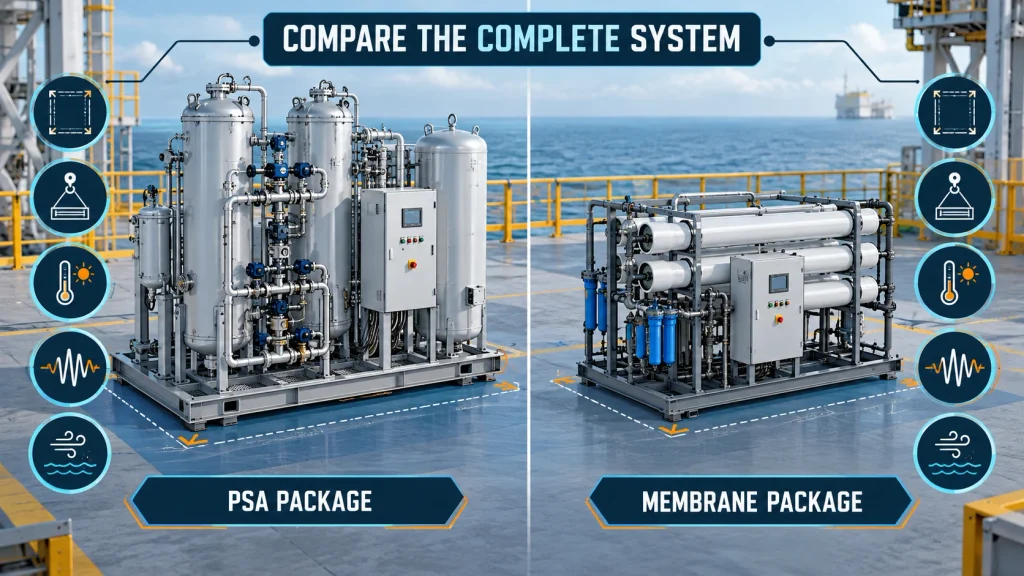
Membrane modules can provide a compact, relatively simple separation stage. That can matter on vessels, offshore platforms, mobile packages and brownfield sites where floor area, lifting weight or motion is constrained. A membrane module alone, however, is not the complete installation. Filters, receivers, controls, analyser, exhaust routing and sometimes a dryer or booster still require space.
PSA packages normally include adsorber vessels, switching valves and exhaust silencers. Vessel geometry and buffer requirements can increase the envelope, particularly when redundancy or storage is included. Modular or parallel arrangements may help with transport, turndown and future expansion, but they must be evaluated as an integrated system.
Neither technology should be selected from footprint alone. Record maximum and minimum temperature, humidity, altitude, dust or salt exposure, ventilation, noise limits, vibration, motion, corrosion category, hazardous-area classification, enclosure rating and applicable marine or offshore rules. These conditions can change capacity, materials, controls and the location of exhausts.
Start-Up, Turndown and Load Profile
Membrane separation responds quickly once suitable compressed air is available and operating conditions stabilise. This can suit intermittent demand or equipment that must start without waiting for adsorption beds to complete repeated cycles. The actual time to deliver on-spec gas still depends on purge volume, analyser response, downstream piping and the control system.
PSA systems operate cyclically and are often applied to stable continuous loads. Modern controls may adjust cycles, isolate off-spec gas, sequence multiple units or stop the generator during low demand. Performance at partial load is model-specific; reducing demand does not automatically reduce energy in direct proportion.
Describe the demand profile rather than providing only an average flow:
- normal, minimum and peak flow;
- peak duration and frequency;
- hours per day and days per year;
- start-stop frequency and required start-up time;
- acceptable off-spec handling during start-up or upset;
- future load increase;
- required availability and whether N+1 redundancy is justified.
A receiver can cover some short peaks, but it cannot correct a sustained capacity shortfall. The nitrogen generator sizing guide should be used to separate average demand, peak demand and storage duty.
Maintenance and Consumables
Membrane systems are often described as having few moving parts in the separation module. That does not mean the complete plant is maintenance-free. Upstream filters, drains, compressor, dryer, valves, analyser and instruments still require inspection and service. Oil, liquid water, particles or excessive temperature can damage performance, so feed-air protection is part of the maintenance strategy.
PSA maintenance additionally focuses on switching valves and actuators, exhaust silencers, cycle performance, adsorbent protection and vessel pressure integrity. Carbon molecular sieve is not normally treated like a frequently replaced filter element, but contamination, attrition, abnormal pressure cycling or poor operating conditions can shorten its useful life.
For both technologies, compare the proposed maintenance plan rather than relying on a label such as “low maintenance.” Request:
- preventive-maintenance tasks and intervals;
- recommended spares for two years of operation;
- expected replacement assumptions for valves, filters, analysers, adsorbent or membrane modules;
- remote support and local service scope;
- performance checks that indicate deterioration;
- downtime required for routine and major service.
Where Each Technology Often Fits
The following examples are screening cues, not design rules. The process oxygen limit and project conditions always take priority.
PSA often enters the shortlist when:
- the process needs high-purity nitrogen or a low residual-oxygen limit;
- the load is substantial and relatively continuous;
- stable product quality across a defined operating range is important;
- the project can accommodate adsorber vessels, switching valves and buffer volume;
- the operator wants a packaged industrial system for food, electronics, heat treatment, chemicals or other purity-sensitive duties, subject to application requirements.
Review the PSA nitrogen generator page only after the required purity, flow and pressure have been defined.
Membrane often enters the shortlist when:
- moderate-purity nitrogen satisfies the process oxygen limit;
- fast response and straightforward start-stop operation matter;
- space, weight, mobility or installation simplicity is a strong constraint;
- the package must be considered for marine, offshore, remote or mobile duty;
- the project values a continuous separation stage with relatively few moving parts.
See the membrane nitrogen generator page for the relevant equipment route, then verify the quoted performance at the project conditions.
Project Decision Matrix
| If the project priority is… | Preliminary direction | Do not decide until you verify… |
|---|---|---|
| Very low residual oxygen | Start with PSA | Guaranteed purity, flow, air ratio, analyser and off-spec control |
| Moderate purity with tight space or weight | Evaluate membrane first | Complete package envelope, feed-air equipment and temperature derating |
| Rapid or frequent start-stop duty | Membrane may have an advantage | Time to on-spec gas at the actual sample point |
| Stable continuous high-purity load | PSA may have an advantage | Part-load controls, redundancy, buffer and valve service plan |
| Marine, offshore or mobile package | Membrane is often shortlisted | Motion, vibration, corrosion, hazardous area, class and exhaust routing |
| Lowest operating cost | Model both technologies | Same duty, boundary, electricity price, maintenance, availability and equipment life |
| Future capacity expansion | Either can be modular | Header design, compressor capacity, controls and space reservation |
A matrix narrows the shortlist; it does not replace a proposal comparison. When both technologies can satisfy the specification, request two aligned configurations and compare total installed and operating scope.
Information Needed for a Project-Specific Comparison
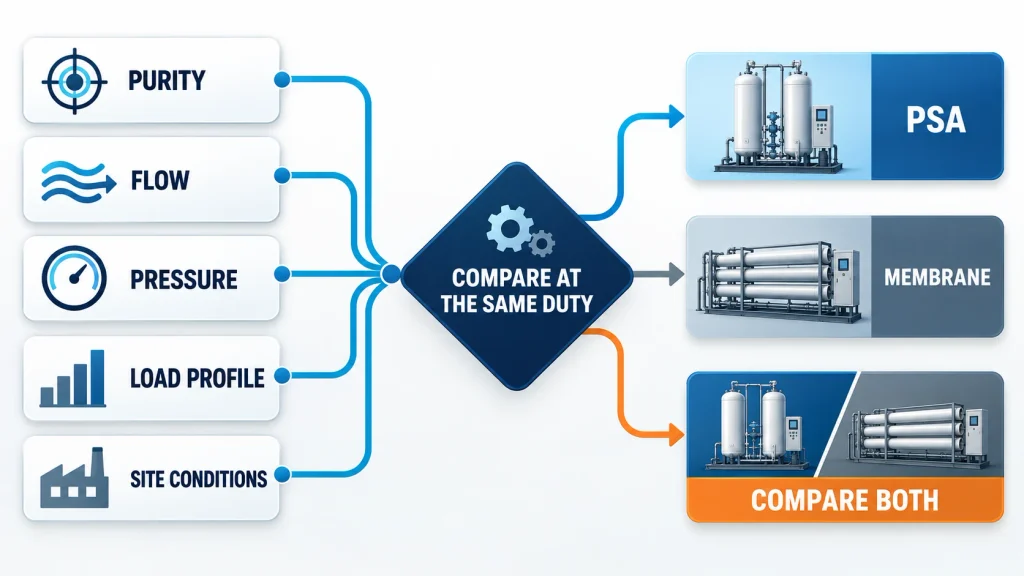
Provide the same input sheet to every supplier. At minimum, include:
- Application and failure mechanism: what nitrogen does and what happens if oxygen or moisture is too high.
- Purity: minimum nitrogen concentration or maximum residual oxygen, measurement point and acceptance method.
- Flow: normal, minimum and peak Nm³/h or scfm, with reference conditions.
- Pressure: required pressure at the process battery limit and maximum allowable pressure drop.
- Dew point and contaminants: moisture, oil, particle or other gas-quality limits.
- Operating profile: hours, start-stop pattern, peak duration, turndown and future growth.
- Site conditions: temperature, altitude, humidity, dust, salt, motion, vibration, hazardous area and utilities.
- Availability: redundancy, backup supply, bypass and allowable downtime.
- Package boundary: compressor, dryer, filters, receivers, analyser, booster, storage, skid, container and installation scope.
- Commercial basis: electricity price, service horizon, spare-parts basis and required warranty or performance test.
The supplier comparison should return guaranteed product conditions, required feed air, installed power, expected consumption at defined load points, equipment list, exclusions, maintenance schedule, control narrative and acceptance-test method.
Frequently Asked Questions
Is PSA better than a membrane nitrogen generator?
Not universally. PSA is often favoured for higher-purity and stable continuous duties. Membrane technology is often favoured where moderate purity, fast response, compactness, low weight or motion tolerance matters. The correct choice is the one that meets the same defined duty at the best lifecycle and project risk.
Which technology produces higher-purity nitrogen?
PSA product families commonly extend to higher purities than membrane product families. However, published ranges overlap and vary by model. Specify the maximum residual oxygen and required flow, then verify the vendor guarantee at the stated inlet and ambient conditions.
Which nitrogen generator uses less energy?
There is no universal answer. Purity, pressure, temperature, air ratio, compressor efficiency, dryer loss, part-load control and booster duty all affect consumption. Compare total package kWh per unit of usable nitrogen at the same conditions and boundary.
Does a membrane nitrogen generator require a dryer?
It requires feed air that meets the membrane supplier’s specified quality and temperature limits. The necessary dryer and filtration arrangement depends on compressor type, ambient condition, membrane design and the required product-gas quality. Do not omit air treatment without written vendor approval.
Which option is easier to maintain?
Membrane separation modules have few moving parts, but the complete system still includes serviceable air treatment, controls and instrumentation. PSA adds cyclic valves, silencers and adsorption-bed protection. Compare the documented maintenance tasks, spares, downtime and replacement assumptions for the complete packages.
Project comparison
Compare PSA and Membrane at Your Actual Duty
Send the application, flow profile, purity, pressure, dew point, operating hours and site conditions. NITRAISE can use those inputs to prepare a preliminary technology comparison. Final performance and scope remain subject to verified data and the agreed written proposal.
About the author: Henry Xu
Henry Xu is the founder of NITRAISE and a senior industrial equipment engineer with 18 years in nitrogen equipment research, development and production.